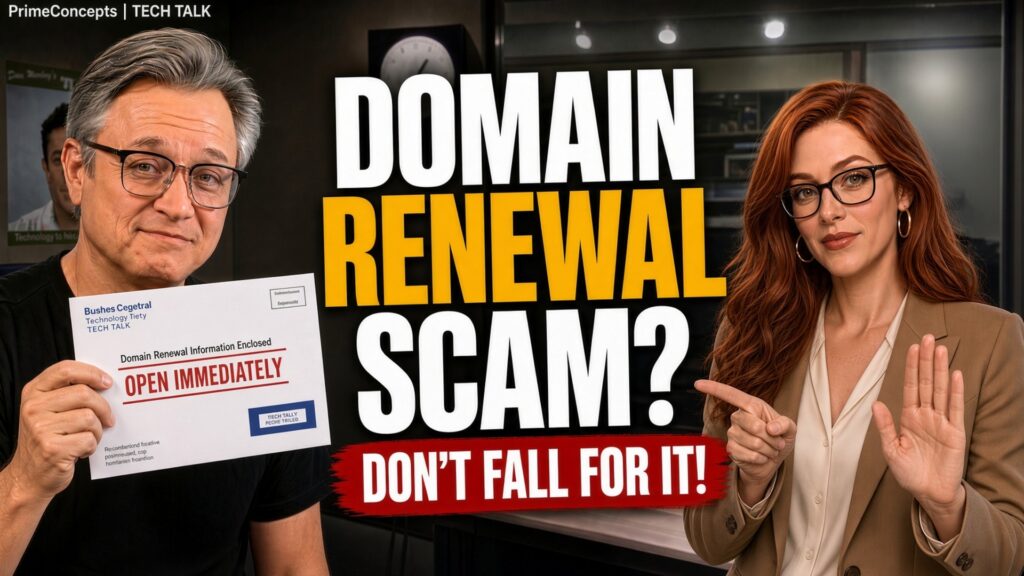
DON’T FALL FOR DOMAIN NAME SCAMS!
That official-looking domain renewal notice in your mailbox—or the urgent email telling you your domain is about to expire—may not be coming from your domain registrar at all.
I’ve been registering and managing domain names for decades, and because I manage a lot of domains, I receive these solicitations all the time.
Some arrive by email. Others still arrive through good old-fashioned U.S. mail.
And some of them look remarkably convincing.
In the latest episode of Tech Talk with Dan Harley, Sophia and I take a real domain renewal solicitation that arrived in my mailbox and break down exactly how these things work.
There was one twist:
I deliberately left the envelope sealed until we recorded the show.
So neither the price nor the fine print had been reviewed before we opened it on camera.
WATCH: DON’T FALL FOR DOMAIN NAME SCAMS!
YouTube Video:
https://youtu.be/XlLXClCq3-o
IT LOOKS LIKE AN OFFICIAL DOMAIN RENEWAL
The envelope I received had several things designed to get my attention.
It included my actual domain name.
It said:
“Renewal Information Enclosed”
And prominently:
“OPEN IMMEDIATELY”
It looked important.
That’s exactly why these solicitations can be so effective.
If you own dozens of domains and deal with registrations regularly, you may recognize something like this immediately.
But most small-business owners don’t own dozens of domains.
They may have one.
Maybe two.
Their domains may automatically renew every year, so they rarely even think about domain registration.
Then something arrives saying their domain is about to expire.
The natural reaction is:
“I better pay this before my website goes down.”
And that’s where the trouble can begin.
HOW MUCH SHOULD A DOMAIN ACTUALLY COST?
During the episode, Sophia and I compared the cost of an ordinary .com domain at several established registrars.
Prices vary, and promotional first-year pricing can be different from renewal pricing, but an ordinary .com domain generally costs somewhere in the tens of dollars per year.
That’s important because of what we found when we finally opened the envelope.
The solicitation wanted:
$265 FOR FIVE YEARS
That’s:
$53 PER YEAR
But the price wasn’t actually the most important part.
The fine print was.
THIS WASN’T JUST A NORMAL RENEWAL
When we opened the letter and started reading it, we found language explaining that the recipient could:
“switch today to Domain Name Services”
and:
“transfer and renew your name from your current registrar to Domain Name Services.”
The letter also contained an important disclaimer:
“This notice is not a bill.”
So technically, the document disclosed what it was offering.
But visually, it looked remarkably similar to something a business might interpret as a normal domain renewal notice.
It had a requested payment date.
It had a payment amount.
It had a QR code for online payment.
It had an expiration date.
And it contained language warning about the potential consequences of failing to renew the domain.
That’s why reading the fine print matters.
DON’T JUST PAY IT
If you receive something like this, my recommendation is simple:
DON’T PANIC.
DON’T BLINDLY PAY.
DON’T CLICK THE LINK.
VERIFY.
If someone tells you your domain is expiring, go directly to the registrar you already use.
Don’t use the link in the email.
Don’t scan a questionable QR code.
Don’t rely on the telephone number in a suspicious notice.
Open your browser yourself, go directly to your registrar, log into your account, and check the domain.
WHAT’S THE WORST THAT COULD HAPPEN?
At the least-dangerous end, you may simply pay too much.
Maybe you pay the wrong company.
Maybe you purchase a service you didn’t need.
Maybe you transfer your domain to another registrar without realizing that’s what you’re doing.
But domain problems can become much more serious.
Your domain isn’t just the address of your website.
For many businesses, it is connected to:
• Your website
• Your business email
• Your online identity
• Customer communications
• DNS and other Internet services
Lose control of the domain and suddenly this isn’t about wasting $50 or $100.
Your website could stop working.
Your email could stop working.
Customers may have difficulty reaching you.
Services connected to the domain could potentially be disrupted.
And in a genuinely malicious situation, someone who obtains control of a valuable business domain could potentially attempt to hold that asset hostage.
Now you have a cybersecurity and legal problem.
I’VE SEEN HOW BAD DOMAIN CONTROL PROBLEMS CAN GET
Years ago, I was brought into a lawsuit as an expert witness involving a web design company and one of its clients.
The web designer had become quite successful locally and worked with numerous businesses and organizations.
From the outside, nothing initially appeared particularly unusual.
Then one of the company’s clients—a substantial construction business—ran into a problem involving its domain, website and branding assets.
The situation ultimately raised a fundamental question:
WHO ACTUALLY CONTROLLED THE COMPANY’S DIGITAL ASSETS?
As part of the litigation, I examined the technical evidence, including the domain registration.
What started with one client eventually exposed a much broader problem involving domains associated with numerous clients.
The dispute went on for months.
There were tens of thousands of dollars in legal expenses.
I eventually helped verify that the technical assets were properly transferred.
The client prevailed, but it had the resources necessary to fight the case.
Many small businesses don’t.
That’s a story worthy of an entire Tech Talk episode of its own, and we’ll come back to it.
The lesson for today is much simpler:
KNOW WHO CONTROLS YOUR DOMAIN.
EMAIL DOMAIN SCAMS CAN BE EVEN MORE DANGEROUS
The example we opened on Tech Talk arrived through regular mail.
Today, however, many domain registration and renewal scams arrive through email.
You’ve probably seen messages like:
URGENT: Your Domain Expires Today
FINAL NOTICE: Domain Renewal Required
Your Website Will Be Suspended
Payment Failed — Renew Immediately
Domain Expiration Notification
The danger with email is that there’s usually a convenient button:
RENEW NOW
Clicking that button could take you somewhere designed to resemble a legitimate registrar.
And now the objective may not simply be getting you to pay an inflated renewal fee.
A phishing site could potentially be trying to obtain your:
• Registrar username
• Password
• Credit card information
• Account information
• Domain transfer credentials
If criminals obtain the credentials to your registrar account, you’ve potentially handed them the keys to one of your business’s most important digital assets.
GO DIRECTLY TO YOUR REGISTRAR
If you receive a domain expiration or renewal email, don’t automatically trust the link.
Instead:
Open a new browser window.
Type the address of your registrar yourself.
Log into your account.
Check the domain.
If it really needs attention, you’ll see it there.
It’s a simple habit that can prevent a very expensive mistake.
DON’T KNOW WHERE YOUR DOMAIN IS REGISTERED?
You’d be surprised how many business owners don’t.
Maybe an employee registered it years ago.
Maybe your web designer handled it.
Maybe an old marketing company did it.
Maybe you simply don’t remember.
That’s okay.
But it’s something you should find out before there’s a problem.
If you’re not sure where your domain is registered—or you receive a suspicious renewal notice and aren’t sure what to do—give us a call.
WE’LL HELP YOU FIGURE IT OUT FOR FREE.
No obligation.
No hard sell.
I’d rather spend a few minutes helping somebody determine where their domain is registered than hear later that they paid the wrong company—or worse, lost control of their domain.
DON’T PANIC. DON’T BLINDLY PAY. VERIFY.
Something like the letter we opened may look like junk mail.
Your domain isn’t.
For a business, your domain can be one of your most important digital assets.
So when somebody tells you that your domain is about to expire:
DON’T PANIC.
DON’T BLINDLY PAY.
DON’T CLICK THE LINK.
VERIFY.
MORE TECH TALK WITH DAN HARLEY
For more information about domain names, cybersecurity, artificial intelligence, Internet marketing, small-business technology and other practical technology topics, visit:
https://PrimeConcepts.net/TechTalk
You’ll find complete Tech Talk with Dan Harley episodes, blog posts, show notes, additional resources, and links to watch on YouTube or listen through your favorite podcast platform.
And here’s something that’s becoming increasingly unusual these days:
WE HAVE A PHONE — AND WE ACTUALLY ANSWER IT.
Call PrimeConcepts:
760-247-4814
Have a technology question?
Received a suspicious domain notice?
Have a problem you’re trying to solve?
Or have an idea for a future Tech Talk episode?
Give us a call.
WATCH THE FULL EPISODE
DON’T FALL FOR DOMAIN NAME SCAMS!
https://youtu.be/XlLXClCq3-o
Tech Talk with Dan Harley
PrimeConcepts for Internet Solutions
760-247-4814
PrimeConcepts.net/TechTalk