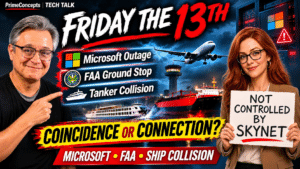
OK people… apparently, the world nearly stopped while Danny and I were out camping. Microsoft services went sideways, the FAA halted departures nationwide, and a tanker hit a river cruise ship. I leave civilization for a little fresh air, and this is what happens?
As much as I would LOVE to blame Bill Gates for everything, the calendar is not evidence. These Friday the 13th technology failures make an unforgettable headline, but understanding them takes more than connecting three scary dots. Here is what we know as of November 16, 2026, what remains preliminary, and what business owners should take away.
Watch the Full Episode
Sophia and I unpack the chaos in the video above. Watch the full Tech Talk episode on YouTube, then come back for the practical business lessons. One timing correction matters: Microsoft’s disruption began Thursday, November 12, and extended into Friday. The aviation and river incidents occurred Friday, November 13.
Microsoft Outage: When the Cloud Has a Bad Day
Microsoft’s disruption affected Exchange Online mailbox access and functions in other Microsoft 365 services that depend on email. For businesses, that meant interrupted communication and workflows. An unavailable inbox can quickly become a customer-service problem.
Microsoft’s preliminary account describes a latent defect in its networking gateway software, combined with changed traffic patterns and reduced available capacity. As servers became unresponsive, redirected traffic overwhelmed others, spreading the failure. Recovery required an update and controlled restoration. Microsoft said it had no indication of malicious activity. This remains a preliminary explanation, with a fuller review still to come; it is not evidence that ordinary customer PCs need a matching Windows repair.
The lesson is uncomfortable: paying a major provider does not eliminate operational risk. A cloud subscription still needs a continuity plan. Before reinstalling Outlook or repeatedly changing passwords, check official service health and determine whether the problem is local or widespread.
FAA Ground Stop: Infrastructure Meets Its Limits
The FAA says telecommunications instability prompted a nationwide ground stop Friday afternoon. Its November 15 explanation identifies excessive connection attempts on its legacy network, with two sites under initial investigation. Blocking those sites stabilized the network; the root-cause investigation continued.
A ground stop restricts departures. It does not mean every airplane already flying suddenly lost guidance. The FAA says some radio frequencies and radar feeds remained available, and existing procedures enabled aircraft to land safely. The agency reported no indication of a cyberattack.
Aging infrastructure deserves attention, but newer equipment also has to work safely with existing systems. For a small business, that is a reminder to review the old firewall, switches, phone equipment, and unsupported software everyone has learned to ignore. “It worked yesterday” is a status report, not a replacement strategy.
Mississippi River Collision: A Serious Event, Not Just a Headline
In New Orleans, the Atlantic Asphalt tanker struck the docked American Heritage river cruise vessel on Friday. The riverboat capsized. Everyone aboard survived, although people were injured. The rescue effort deserves recognition beyond the dramatic footage.
Officials’ preliminary account identified a steering casualty: the tanker’s rudder remained turned to starboard before the collision. Why that steering problem happened was still under investigation. Identifying a failed system does not establish the underlying mechanical, electrical, software, maintenance, or human factors.
We should resist turning a marine accident into a cybersecurity diagnosis without evidence. The useful parallel for businesses is dependency: one critical component can affect an entire operation. Knowing where those components are—and preparing a response—matters before something fails.
Coincidence or Connection?
Three alarming stories close together practically write their own conspiracy script. Friday the 13th supplies the soundtrack. Evidence still has to do the work.
No verified evidence establishes a connection or coordinated cyberattack among these incidents. Separate investigations have described different immediate problems. A shared date, a dramatic video, and widespread dependence on technology do not prove a common cause. We will update our understanding when verified findings change, rather than promote a theory because it makes a better thumbnail.
What Businesses Can Learn from Friday the 13th Technology Failures
You cannot personally repair Microsoft’s infrastructure or an air traffic network. You can decide what your business does when a service it relies on disappears.
- Back up important information and test restoration. Confirm what your provider retains, what your separate backups protect, and how long recovery takes. A successful backup notification is less useful than a demonstrated restore.
- Prepare alternate communications. Keep essential contact details accessible outside your primary inbox. Decide how staff will coordinate and how customers will receive updates if email or business phones fail.
- Map your dependencies. List the internet connection, identity provider, email, payments, scheduling, and business applications needed to operate. Two tools may share the same underlying provider.
- Maintain cybersecurity basics. Use multifactor authentication, supported software, updates, and staff awareness. Outages can also attract fake support messages. Verify recovery instructions through trusted channels.
- Write a recovery plan people can use. Assign responsibility, establish when to switch to a workaround, and identify which services to restore first. Practice a short scenario with the team.
Start with one question: if your main system stopped working for a business day, what could you still do? That conversation often uncovers more than buying another gadget. A simple, tested process can keep a temporary interruption from becoming a much larger mess.
Meet the AI Team
Sophia is my AI cohost on Tech Talk, helping turn complicated technology stories into useful conversations. Nina, our Grok-powered research investigator, helps dig into claims and questions behind the headlines. I bring the real-world IT and business perspective—and occasionally the camping excuse.
AI helps us research and explain. Sources and human judgment remain essential, especially while incident findings are developing.
Prepare Before the Next Bad Technology Day
Watch the episode, subscribe to Tech Talk, and share it with the business owner whose recovery plan currently consists of unplugging everything and hoping. We have all met that person. Sometimes we have been that person.
Need practical help with IT, backups, cybersecurity, alternate communications, or business continuity? Contact PrimeConcepts or call 760-247-4814. Let’s identify what your business needs to keep moving—even when the calendar has a sense of humor.
Sources and Reporting Notes
Checked November 16, 2026: Microsoft executive Charles Lamanna’s preliminary explanation; FAA ground-stop questions and answers; and Reuters reporting on the NTSB briefing. Initial findings can change as investigations progress.