My Mom Nearly Got Scammed—Why We Built Prime CyberSafe for Seniors
My mom nearly had her bank account compromised twice in one week. Fortunately, protections I had already put in place helped prevent losses. But when I talked with friends, I kept hearing versions of the same story: their mom, dad or grandparent had encountered something similar.
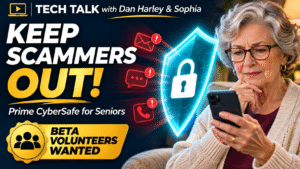
That helped inspire Prime CyberSafe for Seniors, or PCSS. We’re developing a practical combination of protection, education and support for people who want to use technology with more confidence.
Watch the full Tech Talk episode
In this episode, Dan Harley and AI co-host Sophia explain how PCSS began, what the pilot is teaching us, and why we’re inviting more everyday users to help build it.
Technology: a protective safety net
We started with security tools I already use to help protect business clients’ computers. Applying those tools to participants’ computers gave us a foundation for the pilot.
No security tool makes someone immune to scams. The goal is to reduce risk and help identify and address problems. We’re also exploring expanded phone and tablet protection because many participants spend more time on their phones than on a computer.
Education: explanations people can actually use
A training program can be technically impressive and still miss its audience.
After listening to one provider explain a program filled with industry terminology, I asked a simple question: “Does your mom understand what you just said?”
That is the standard we want our educational materials to meet. Practical lessons should help people recognize suspicious requests, pause before clicking, and know where to ask for help.
For example, an alarming pop-up is a reason to stop and verify what is happening—not to call an unfamiliar number or grant remote access to someone who unexpectedly contacts you.
Support: someone you feel comfortable asking
During this small pilot, I’ve handled assistance personally, often remotely. So far, I’ve received roughly one support call a week, usually about a relatively minor issue. That is my experience with the current group, not a promise about future support demand.
The bigger challenge is growing without losing patience, clear communication and affordability. We’re evaluating support options, including potential AI assistance. Ideas discussed in the episode are development possibilities, not a promise of round-the-clock or autonomous support today.
Why our beta team needs everyday people
We need feedback from the people who would actually use PCSS. Technical expertise isn’t a requirement.
“This confused me” is useful feedback. So are “I couldn’t follow those instructions” and “That explanation helped.”
Our current participants have helped us see where the program needs to improve. We’re inviting a limited number of additional volunteers to contribute their everyday experience.
Interested in helping?
Participation is voluntary. There is no participation fee for now, no compensation and no purchase obligation. Visit Prime CyberSafe for Seniors and complete the interest form at the bottom of the page.
If someone in your family could benefit, share the episode with them. Our aim is to help seniors feel more confident using technology and more comfortable asking for help.
PCSS remains a pilot program. Features and availability may change as development continues. No service can prevent every scam or threat.